Mixed-Method Assessment of Indoor Environmental Quality in an Educational Multipurpose Hall: A Case Study of Dewan Jubli Perak, Politeknik Ungku Omar
Keywords:
Indoor environmental quality, multipurpose hall, illuminance, ICOP-IAQ 2010, mixed-method assessmentAbstract
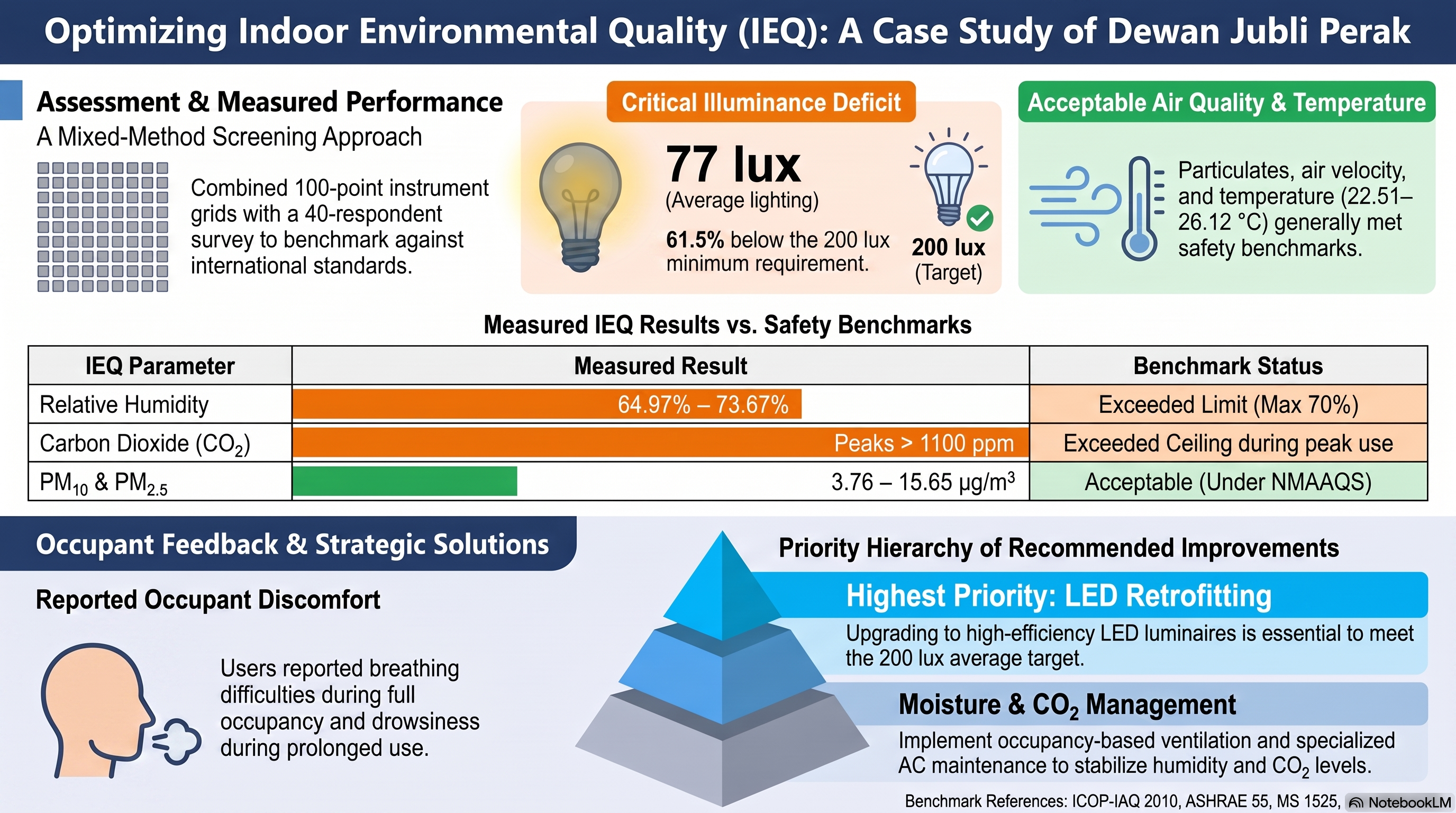
Indoor Environmental Quality (IEQ) is important for occupant comfort, health and concentration in educational buildings, especially in multipurpose halls used for examinations and formal activities. However, these spaces are often assessed based on complaints rather than systematic measurement. This study evaluated the IEQ performance of Dewan Jubli Perak, Politeknik Ungku Omar, using a selected-parameter mixed-method approach. Seven parameters were assessed: air temperature, relative humidity, air velocity, carbon dioxide (CO₂), particulate matter (PM₁₀ and PM₂.₅) and illuminance. Continuous measurements were conducted from 7 to 10 May 2026 at a representative occupied zone, while illuminance was measured using a 10 × 10 grid consisting of 100 points. Occupant perception was obtained through a 15-item questionnaire involving 40 hall users. The measured data were benchmarked against ICOP-IAQ 2010, ASHRAE Standard 55-2020, MS 1525 and the New Malaysia Ambient Air Quality Standard. The results showed that air temperature ranged from 22.51 to 26.12 °C and was generally close to the recommended range, while air velocity remained acceptable between 0.172 and 0.200 m/s. PM₁₀ ranged from 3.76 to 13.52 µg/m³, and PM₂.₅ was recorded at 15.65 µg/m³, indicating acceptable particulate levels. CO₂ was mostly below the 1000 ppm ceiling, although short exceedances above 1100 ppm occurred during peak occupancy. The main deficiencies were relative humidity and illuminance. Relative humidity reached 73.67%, exceeding the 70% upper limit, while average illuminance was only 77 lux, approximately 61.5% below the 200 lux minimum requirement. Questionnaire responses supported the measured findings, particularly regarding lighting discomfort, breathing difficulty during full occupancy and drowsiness during prolonged use. Overall, the hall showed acceptable performance for several air-quality indicators but did not fully comply with the selected IEQ benchmarks. Priority improvements should include LED lighting upgrades, better humidity control, occupancy-based ventilation monitoring and periodic IEQ reassessment using multiple sampling points and longer monitoring periods